

GPT-5.4 OpenAI-Introduction
The artificial intelligence landscape has entered a new phase. On March 5, 2026, OpenAI introduced GPT-5.4, a model designed specifically for complex professional tasks and enterprise workflows.
Unlike typical AI upgrades, GPT-5.4 OpenAI focuses on improving how artificial intelligence assists with real-world professional work. From financial modeling and legal document analysis to automated software testing, the model is built to function less like a chatbot and more like a digital coworker.
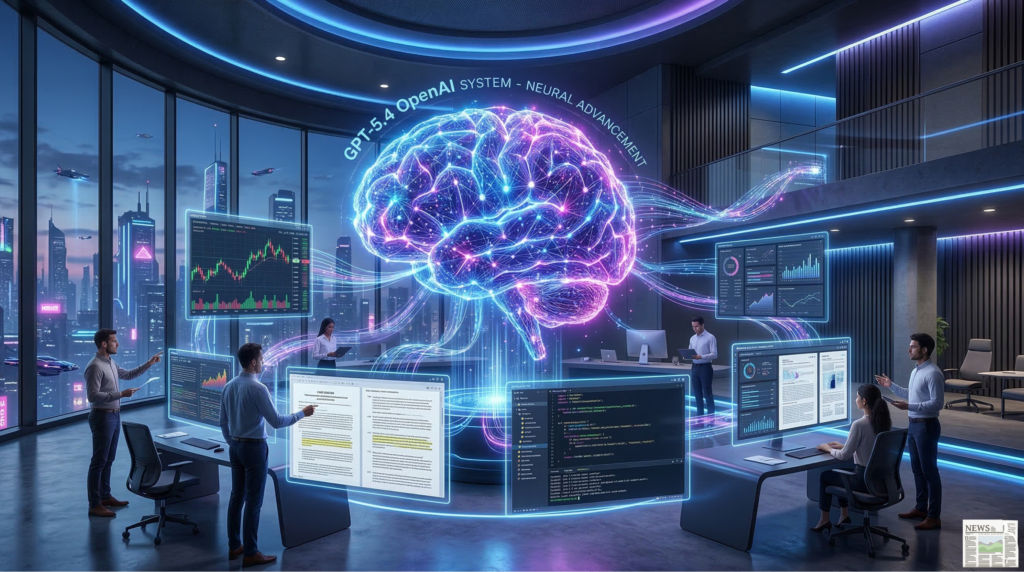
With the debut of GPT-5.4 Thinking and GPT-5.4 Pro, OpenAI is pushing AI reasoning capabilities deeper into modern workplaces. These new variants allow businesses and developers to integrate powerful AI tools into everyday workflows with greater reliability and transparency.
Below is a breakdown of the five most important innovations in GPT-5.4 and why they matter for professionals, developers, and organizations.
1. Advanced Professional Reasoning
One of the most impressive aspects of GPT-5.4 OpenAI is its performance on the GDPval benchmark, which evaluates AI performance across 44 professional disciplines.
The model matched or exceeded human-level performance in 83% of evaluated tasks, highlighting its ability to support demanding knowledge work.
What makes GPT-5.4 particularly valuable is that it produces outputs that look like finished professional deliverables, not rough drafts.
This means:
- Less editing
- Faster workflows
- Higher-quality outputs
Professionals can now rely on AI to produce usable reports, structured analyses, and well-formatted documents right from the start.
Performance Highlights
Financial Modeling
GPT-5.4 achieved 87.3% accuracy on complex spreadsheet tasks.
This represents a major improvement compared to GPT-5.2’s 68.4% score.
Financial analysts can now use AI for:
- Forecast modeling
- Spreadsheet debugging
- Scenario simulations
- Financial risk analysis
Legal Document Analysis
Another major upgrade involves legal reasoning and document analysis.
GPT-5.4 reduced factual hallucinations by 33% when analyzing legal documents.
This improvement makes the model significantly more reliable for:
- Contract review
- Compliance analysis
- Regulatory documentation
- Legal research
While AI cannot replace lawyers, it can dramatically speed up legal review processes.
2. Built-In Computer Interaction
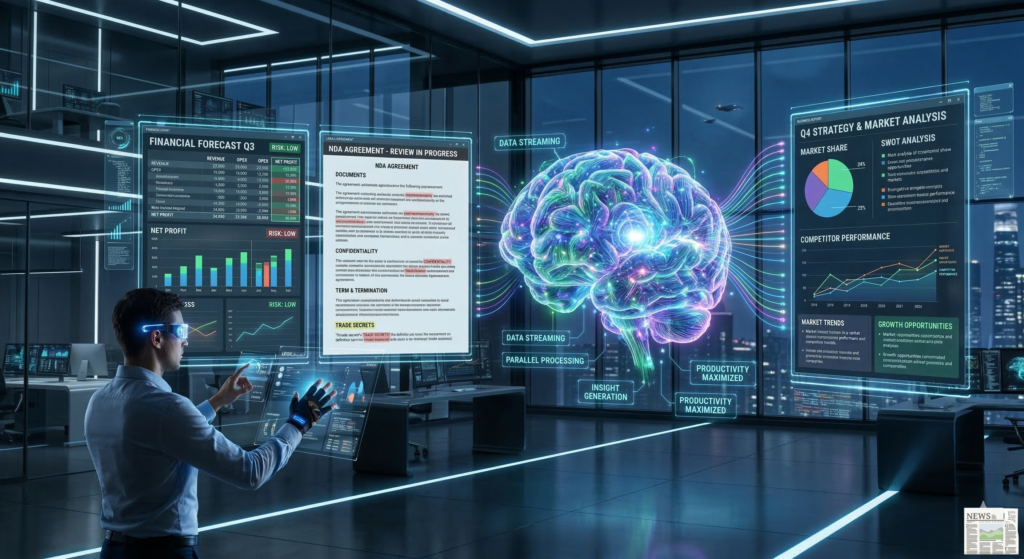
One of the most groundbreaking capabilities introduced in GPT-5.4 OpenAI is native computer control.
The model can observe and interact with a desktop environment, performing tasks using mouse and keyboard commands—just like a human user.
This capability transforms AI from a passive assistant into an active digital operator.
In the OSWorld-Verified benchmark, GPT-5.4 achieved a 75% success rate, exceeding the 72.4% human average.
What This Enables
Developers can now build AI agents that operate software directly, including:
- Navigating complex dashboards
- Automating repetitive office tasks
- Operating legacy desktop software
- Troubleshooting applications through screenshots
For organizations, this opens the door to automation across entire workflows, not just isolated tasks.
In other words, GPT-5.4 moves AI one step closer to functioning like a virtual employee.
3. Real-Time “Thinking” for Better Collaboration
A common frustration with earlier AI systems was lack of transparency. Users often didn’t understand how the AI reached a conclusion.
OpenAI addressed this issue with the Thinking Preamble, a feature that allows GPT-5.4 to outline its reasoning plan before executing complex tasks.
This simple change dramatically improves collaboration between humans and AI.
Why It Matters
Mid-Task Adjustments
Users can review the AI’s strategy before it proceeds.
If the approach isn’t ideal, they can redirect the model early, saving time and improving results.
Better Research Performance
GPT-5.4 can maintain longer reasoning chains, allowing deeper investigation across multiple sources.
In the BrowseComp benchmark, the model achieved 89.3% accuracy, demonstrating strong performance in complex research scenarios.
For analysts, researchers, and consultants, this capability means faster access to deeper insights.
4. Massive Context Window and Developer Efficiency
Developers working with the API will benefit from several efficiency upgrades.
The most notable addition is Tool Search, which allows the model to retrieve tool definitions only when needed rather than loading them constantly.
Key Benefits
Lower Token Usage
Testing shows up to 47% lower token consumption in workflows that rely heavily on external tools.
This reduces operational costs for developers building large AI systems.
1-Million Token Context Window
Another massive upgrade is the 1-million-token context window.
This allows GPT-5.4 to analyze extremely large datasets, including:
- Massive codebases
- Entire legal case archives
- Large financial reports
- Extensive research documents
With this level of context, the AI can maintain coherence across very large projects.
5. Improved Vision and Coding Capabilities
GPT-5.4 also expands its multimodal capabilities, combining advanced coding performance with high-resolution visual processing.
The system now supports images up to 10.24 million pixels.
This enables the AI to read extremely detailed visual materials such as:
- Engineering blueprints
- Technical diagrams
- Dense printed documents
- Architectural plans
Automated Software Testing
Developers also gain access to Playwright Interactive, a feature that allows the AI to test the applications it builds.
It can simulate real user interactions to verify that:
- Interfaces function correctly
- Buttons and forms behave as expected
- User workflows operate smoothly
This capability significantly reduces development and QA testing time.
Why GPT-5.4 OpenAI Matters for the Future of Work
The release of GPT-5.4 OpenAI signals a major shift in how artificial intelligence will be used in professional environments.
Instead of acting only as conversational assistants, AI systems are becoming active participants in complex workflows.
Businesses can now deploy AI for:
- Research analysis
- Data interpretation
- Software development
- Legal review
- Workflow automation

The result is faster decision-making, improved productivity, and reduced operational overhead.
Frequently Asked Questions (FAQs)
1. What is GPT-5.4 OpenAI?
GPT-5.4 is an advanced artificial intelligence model developed by OpenAI, designed specifically for professional workflows such as research, financial analysis, coding, and enterprise automation.
2. How is GPT-5.4 different from previous GPT models?
GPT-5.4 offers several improvements, including:
- Better professional reasoning
- Computer-use capabilities
- A 1-million-token context window
- Reduced hallucinations
- Improved visual and coding abilities
3. What are GPT-5.4 Thinking and GPT-5.4 Pro?
These are specialized versions of the GPT-5.4 model designed for complex reasoning and enterprise-level workloads, offering deeper analysis and enhanced collaboration features.
4. Can GPT-5.4 control a computer?
Yes. GPT-5.4 includes native computer interaction that allows it to operate software using mouse and keyboard commands.
5. What industries benefit most from GPT-5.4?
Industries likely to benefit include:
- Finance
- Legal services
- Software development
- Research and academia
- Business consulting
6. Will GPT-5.4 replace human professionals?
Most experts believe GPT-5.4 will act as a productivity assistant rather than a replacement. It helps professionals work faster and more efficiently but still requires human oversight.
Conclusion
The introduction of GPT-5.4 OpenAI marks a significant milestone in the evolution of artificial intelligence.
With stronger reasoning capabilities, built-in computer interaction, a massive context window, and powerful multimodal features, GPT-5.4 moves AI closer to functioning as a true digital collaborator.
For businesses, developers, and knowledge workers, the implications are profound. AI is no longer just a tool for answering questions—it is becoming an active partner in solving complex problems and executing real work.
As AI systems continue to evolve, tools like GPT-5.4 will likely become a core component of the modern digital workplace.